GCC//GOTHAM//COLLECTIVE
TX.002 ORIGIN // 01 / 05
TX.002 // PROGRAM ROOM 01 CATALOG: 1966 – 1982

ORIGIN.

The history that was not finished — only reclassified. Declassified here, for display, under the GCC signature.

FOUNDED
OCT 15, 1966
ORIGIN
OAKLAND, CA
PEAK CIRCULATION
400,000 / WEEK
SURVIVAL PROGRAMS
60+ DOCUMENTED
CLASSIFICATION
DECLASSIFIED FOR DISPLAY
§A THE DOCUMENT

What We Want.
What We Believe.

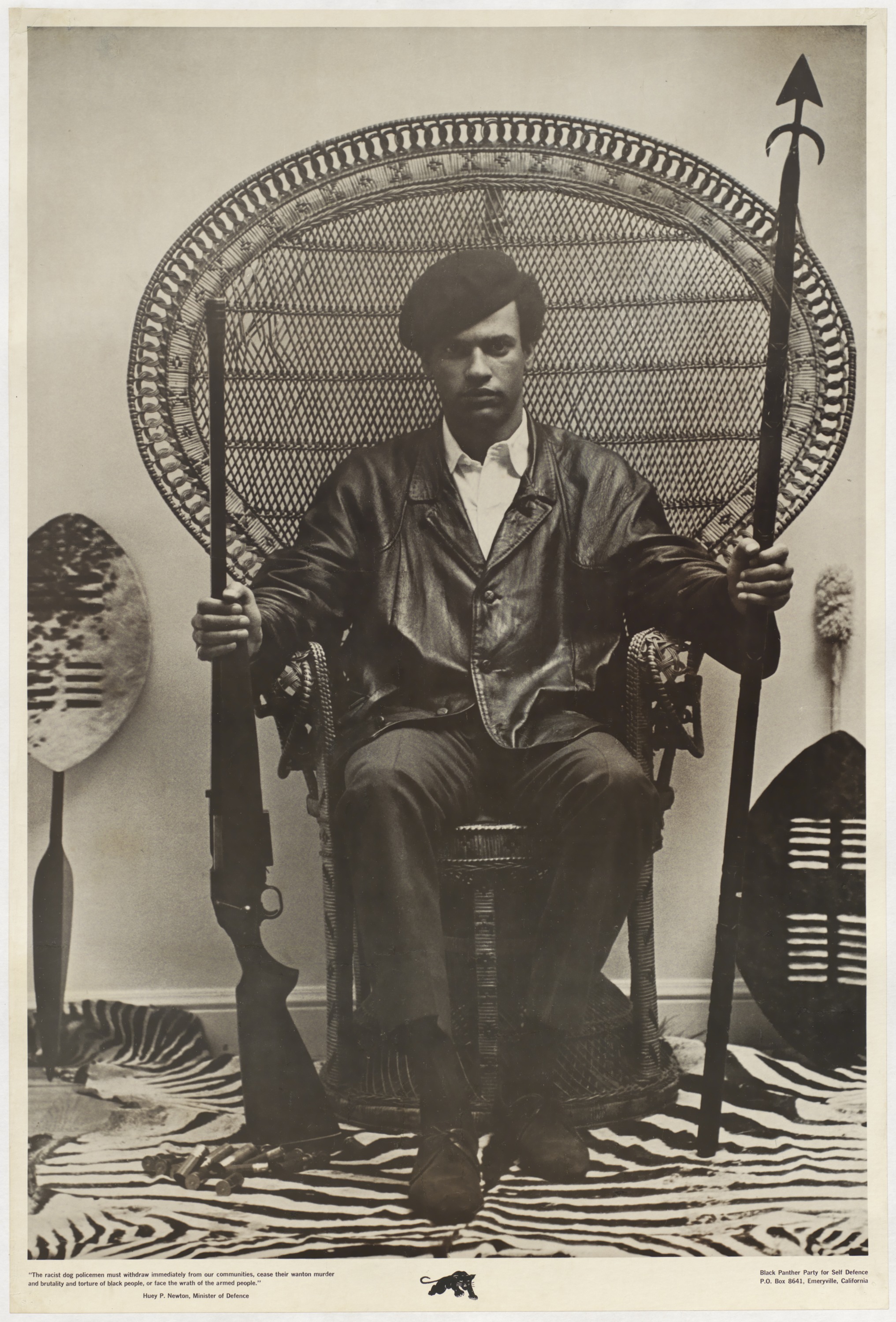
On October 15, 1966, in the North Oakland Neighborhood Anti-Poverty Center, two graduate students at Merritt College sat down with a yellow legal pad and drafted a ten-point program in a single sitting.

Huey P. Newton and Bobby Seale had both read Malcolm X. They had both watched the civil rights movement hit a wall called the Mason-Dixon line and come apart on the other side of it. They had both decided that the next move was a specification, not a prayer.

History calls what they wrote a manifesto. It was a specification.

TITLE
WHAT WE WANT. WHAT WE BELIEVE.
AUTHORS
HUEY P. NEWTON, BOBBY SEALE
DRAFTED
OCT 15, 1966
VERSION ON DISPLAY
REVISED 1972
MEDIUM
YELLOW LEGAL PAD, GRAPHITE
STATUS
ACTIVE
  1. 01
    We want freedom.
    The power to determine the destiny of our Black and oppressed communities.
  2. 02
    We want full employment for our people.
    The federal government is responsible for providing every person employment or a guaranteed income.
  3. 03
    We want an end to the robbery by the capitalists.
    Of our Black and oppressed communities. The wealth that has been extracted, returned.
  4. 04
    We want decent housing.
    Fit for the shelter of human beings.
  5. 05
    We want education that teaches us our true history.
    And our role in the present-day society. Education that exposes, not education that conceals.
  6. 06
    We want completely free health care.
    For all Black and oppressed people. Added to the program in the 1972 revision.
  7. 07
    We want an immediate end to police brutality and murder.
    Of Black people, other people of color, all oppressed people inside the United States.
  8. 08
    We want an immediate end to all wars of aggression.
    Foreign and domestic. The war machine is a racial project.
  9. 09
    We want freedom for all oppressed people held in prisons and jails.
    Federal, state, county, city, and military. Trial by a jury of peers, from the Black community.
  10. 10
    We want land, bread, housing, education, clothing, justice, and peace.
    And people's community control of modern technology. The last clause, added in 1972, made the program futurist in its final form.
§B THE PAPER

The Visual Program.

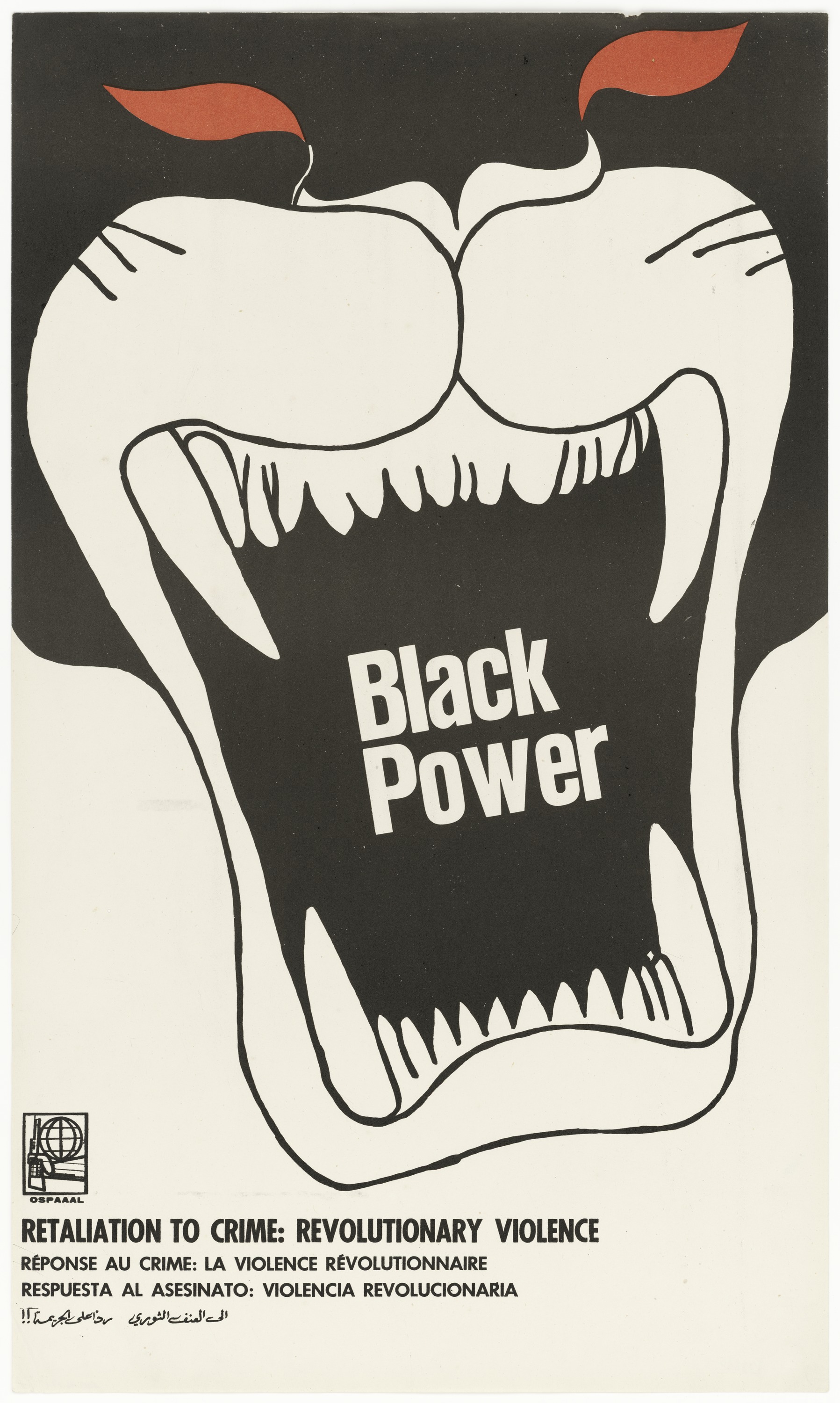
The program had a ten-point specification. It also had a graphic language.

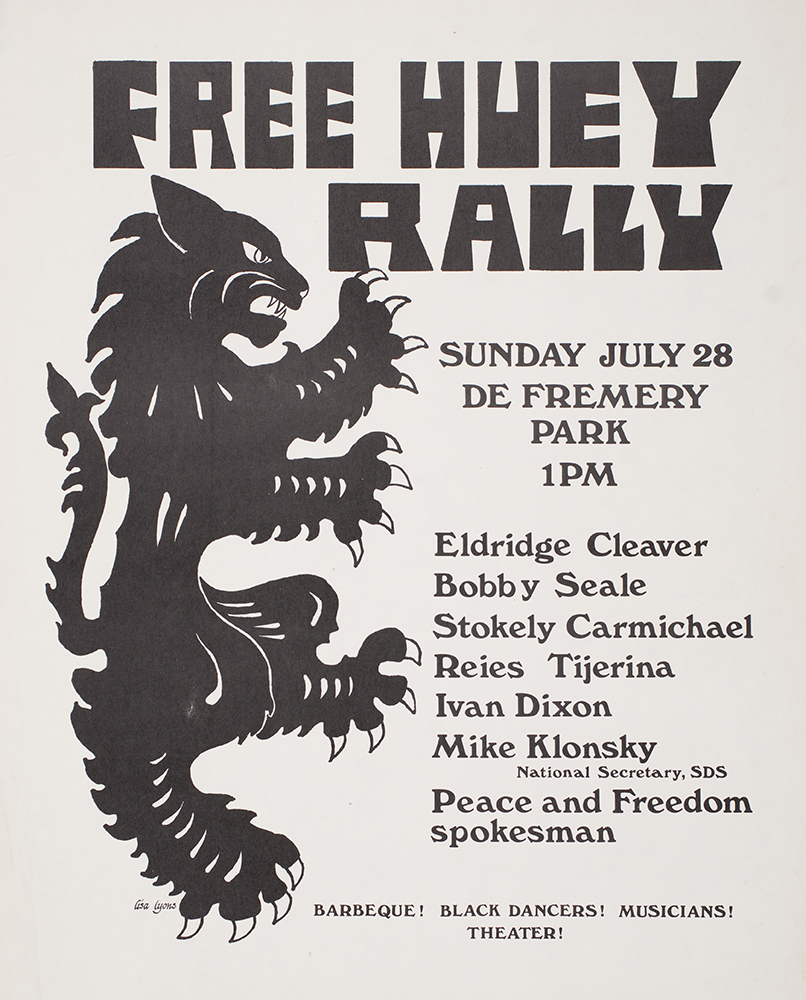
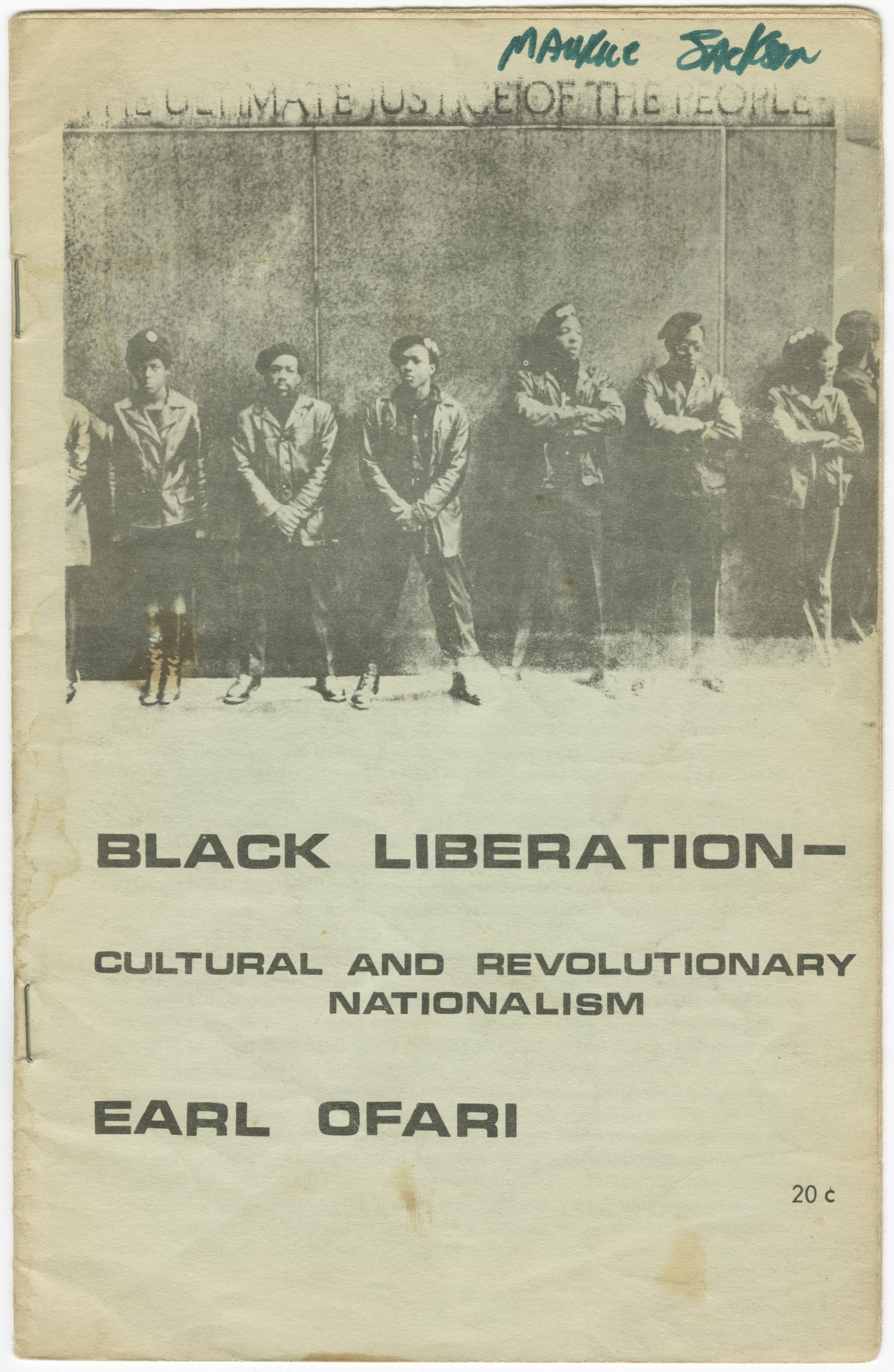
Emory Douglas served as the Party's Minister of Culture from 1967 through the Party's dissolution. As art director of The Black Panther newspaper, he set the visual vocabulary of Black liberation for a generation — flat color, heavy linework, propaganda-disciplined, rendering community members as heroic without idealization.

At peak circulation the paper reached 400,000 readers weekly. Douglas drew most of the covers.

He is 82. Still living

History says guns.
The Party said survival.

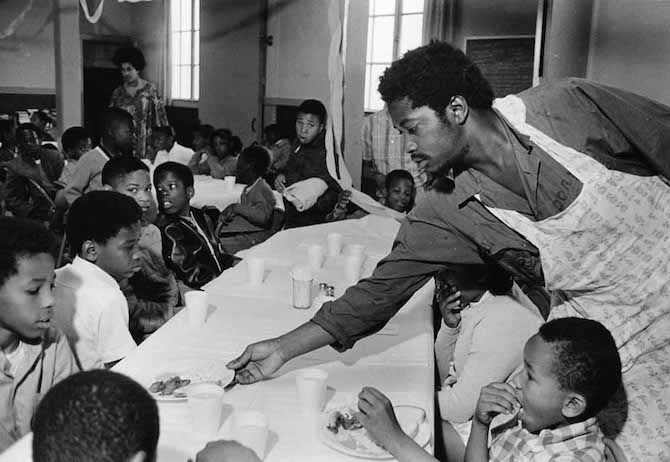
A Black Panther Party member serving breakfast to Black schoolchildren at a long communal table. Multiple children seated and eating, others standing and waiting. Community center interior, 1969.
Free Breakfast for Children · c. 1969 · Oakland This is what the Party meant by survival. A Party member serves breakfast to children at a long communal table before school. Eleven children on day one. One hundred and thirty-five by the end of the week.

By 1971, the Ten-Point Program had generated over sixty documented Survival Programs — material interventions in the conditions of Black life that municipal and federal governments had refused to provide.

Food. Healthcare. Transportation. Education. Legal defense. Escorts for the elderly. Shoes for the children. The programs were free, visible, and reproducible across cities.

1969

Free Breakfast for Children

Launched January 1969 at Father Earl A. Neil's St. Augustine Episcopal Church, Oakland. 11 children the first day. 135 by the end of that week.

Grew to 10,000–20,000 children fed daily across 23 cities by 1971. Mandatory at every BPP chapter. The direct precursor to the federal School Breakfast Program.
1969

People's Free Medical Clinics

Walk-in primary care, screenings, and preventive medicine in neighborhoods abandoned by the medical system.

13 clinics at peak. Staffed by volunteer doctors, nurses, and trained Party members.
1971

Sickle Cell Anemia Foundation

First major US public health campaign on sickle cell. Free screening, counseling, public education.

1M+ screened. Forced federal recognition. Nixon signed the Sickle Cell Anemia Control Act, 1972.
1972

Free Ambulance Service

Emergency medical transport in communities that private ambulance services refused to enter. Winston-Salem, North Carolina.

Operated by the Winston-Salem chapter. Carried active patient load within weeks of launch.
1969

Liberation Schools

Independent primary education centered on Black history, mathematics, and political literacy. Evening and summer sessions.

Matured into the Oakland Community School — state-accredited K-6, operated 1973–1982.
1970

People's Free Legal Aid

Bail funds, court representation, advocacy for members and neighbors. Pattern for later community defense practice.

Worked alongside NLG and sympathetic civil-rights attorneys nationwide.
1971

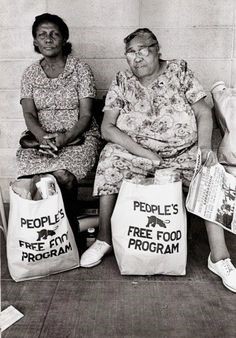
Free Food Program

Grocery distribution. Canned goods, fresh produce, staples. Churches and Party offices as distribution nodes.

Oakland peak: 10,000 bags/month. Replicated in New Haven, Chicago, Winston-Salem.
1972

Seniors Against a Fearful Environment

Escort program. Young Party members walked elderly residents to banks, shops, and clinics on check days.

Known inside the Party as SAFE. Oakland, Berkeley.
1971

Free Shoes Program

New shoes, distributed through the clinic network. Children and adults. No means-testing. No paperwork.

Materially simple. Politically unmistakable. Care, rendered visible.
1973

Oakland Community School

Fully accredited K-6 alternative school. Free. Hot meals. Political education alongside core curriculum.

Commended by the California state legislature. Closed 1982 with the Party.
Two elder Black women seated side by side on a stoop, People's Free Food Program paper bags on the ground between them. Both look directly at the camera. Black and white photograph.
People's Free Food Program · elders with grocery bags The Party delivered groceries weekly to community members — including elders who could not make it to the churches where the breakfasts were served. Not charity. Infrastructure.
FBI — J. Edgar Hoover, 1969 Hoover called the Black Panthers "the greatest threat to the internal security of the country." In a separate 1969 memo, he ordered field offices to disrupt the Free Breakfast Program specifically — naming its effectiveness as the reason it had to be neutralized. The programs were the target, not the rhetoric. When the state's legitimacy rests on neglect, meeting the neglect with care is an act of war.
§D THE PEOPLE

Not icons.
Organizers.

The Party was, at peak, a membership of several thousand across forty-plus chapters. Women were 60%+ by the early 1970s. The names below are eight of its figures — founders, chairs, ministers, organizers. Some are still living. Living is, itself, a part of the archive.

  1. Huey P. Newton
    Co-founder · Minister of Defense · theorist of the Party's practice
    1942 – 1989
  2. Bobby Seale
    Co-founder · Chairman · author of Seize the Time
    b. 1936still living
  3. Emory Douglas
    Minister of Culture · art director, The Black Panther · draftsman of the visual program
    b. 1943still living
  4. Fred Hampton
    Chairman, Illinois Chapter · founder of the original Rainbow Coalition (BPP · Young Lords · Young Patriots)
    1948 – 1969
  5. Kathleen Cleaver
    Communications Secretary · first woman on the Party's Central Committee
    b. 1945still living
  6. Elaine Brown
    Chairwoman, 1974–1977 · first woman to lead the Party · author of A Taste of Power
    b. 1943still living
  7. Ericka Huggins
    Director, Oakland Community School, 1973–1981 · New Haven chapter leader · educator
    b. 1948still living
  8. Aaron Dixon
    Captain, Seattle Chapter — first Party chapter outside California, April 1968
    b. 1949still living
December 4, 1969 // 4:45 AM // Chicago
You can jail a revolutionary,
but you can't jail a revolution.
— Fred Hampton · Chairman, Illinois Chapter
21 years old
§F EXIT

The program was not finished. It was classified.

ROOM 02 // NEXT
THE FOLD
ENTER // ROOM 02